
Library Scent or Custom Development? A Department Store Route
A department store launch does not need a bespoke formula to succeed, and it does not need a library scent to fail. What it needs is a scent that is distinct enough to be repeated by an associate, stable enough to hold for the shelf life, and defensible enough that a competitor cannot buy the same thing next season. The step-by-step route below treats the library-versus-custom decision as one that is made twice: once before sampling and once after the candidates have been scored, which is where most brands get it wrong.
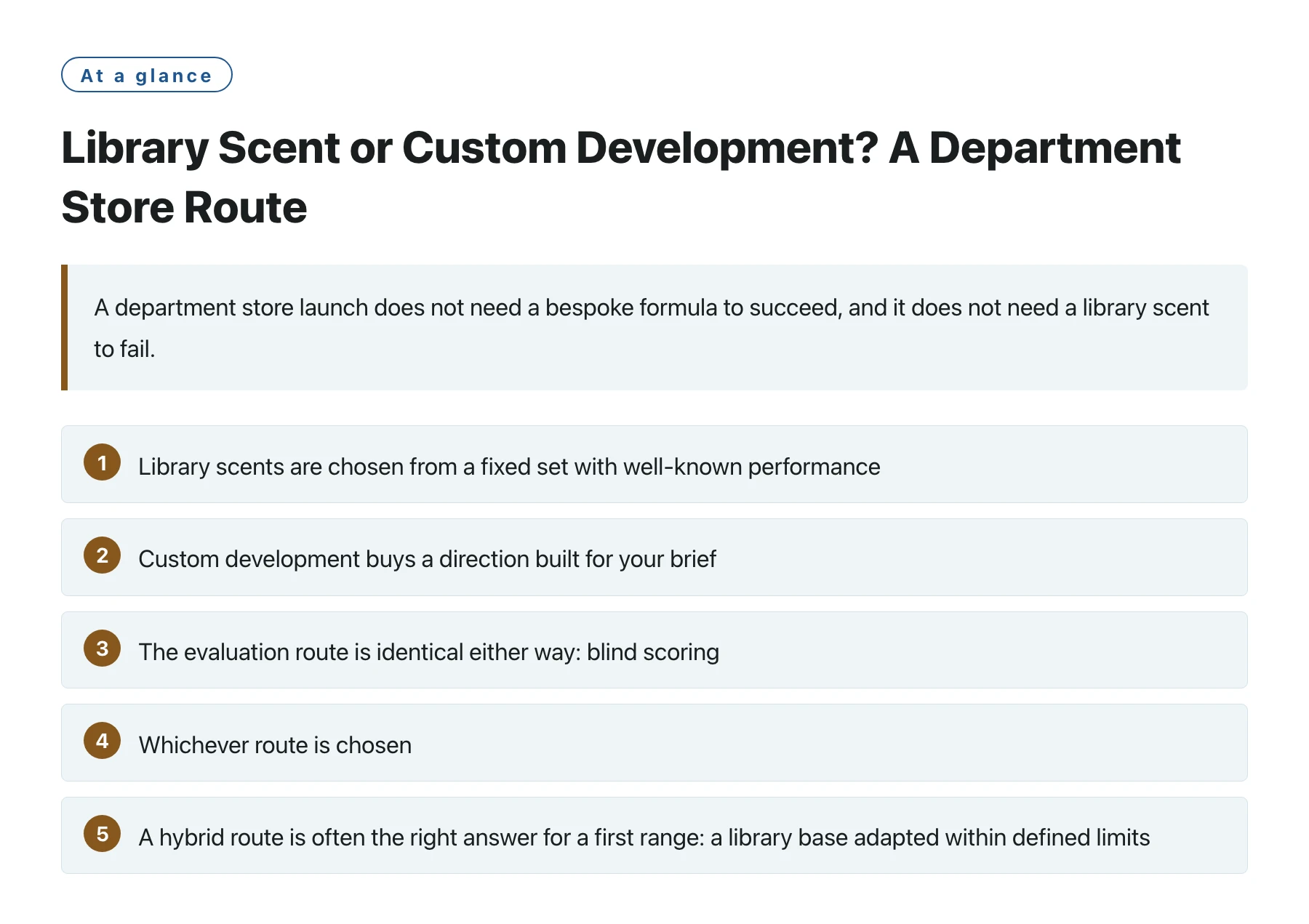
Key takeawaysLibrary scents are chosen from a fixed set with well-known performance, so the practical risk is differentiation rather than quality. · Custom development buys a direction built for your brief, but it also adds a development calendar and a set of ownership questions that a library selection avoids. · The evaluation route is identical either way: blind scoring, in the pack the store will sell, on two separate days. · Whichever route is chosen, the ownership and exclusivity position must be settled in writing before development or selection begins [1]. · A hybrid route is often the right answer for a first range: a library base adapted within defined limits, with the adaptation terms agreed in advance.
Brands preparing a retail launch tend to frame this decision as a trade-off between cost and originality. That framing is incomplete. A library scent is not simply a cheaper option; it is a known quantity with documented performance, which removes an entire class of launch risk. A custom development is not simply more original; it is a programme with its own calendar, its own approvals and its own contract terms.
The department store context sharpens the question. Retail space asks for a range that is easy to explain and hard to confuse with the neighbouring shelf, and the buyer will want to know how the product is protected from being replicated. Both routes can answer that, but they answer it differently, and one of them requires the answer to be negotiated rather than assumed.
Work through the steps below in order. The sequence matters more than the destination, because each step produces the input the next one needs.
Seven steps from proposition to locked decision
- Write the counter proposition firstOne sentence that a sales associate can repeat, and three words that should not describe the scent. This becomes the scoring key for every candidate that follows.
- Shortlist library candidates without looking at pricesAsk for a shortlist mapped to the proposition, then smell it blind. Price information at this stage biases selection toward the cheapest adequate direction.
- Score in the retail pack, on two separate daysEvaluate in the pack the store will sell, score against the proposition, then repeat the exercise at least two days later and compare the scorecards.
- Judge the shortlist on headroom, not only on fitA direction that fits but cannot be adapted without collapsing leaves nothing to negotiate. Ask what can be modified within the library licence and at what cost.
- Write a custom brief only if the shortlist fails on fit or headroomThe brief should describe the effect rather than the materials, and should state which library directions were rejected and why, so the developer does not return to them.
- Cost both routes at the same quantity and scopeA development fee and a library licence are not comparable figures on their own. Put both against the same volume, packaging and testing scope before comparing.
- Settle ownership, exclusivity and the document trail before lockingAgree who owns the composition, what the brand may do with it, and which technical documents travel with it. This step protects the launch more than any other [1].
Library and custom routes side by side
| Dimension | Library selection | Custom development |
|---|---|---|
| What the brand is buying | A defined scent with known performance characteristics and existing documentation | A development programme that produces a scent built for the brief |
| Calendar shape | Sampling and selection only, so the schedule depends mostly on packaging and testing | Selection, refinement and approval rounds, each of which can extend the launch window |
| Cost structure | A licence or usage element plus the product cost, usually lower to enter | A development fee plus the product cost, with the fee sometimes credited against volume |
| Differentiation | Limited by how widely the composition has been used, which is why the licence terms matter | Higher in principle, though a formula developed from a common template may be less unique than it sounds |
| Adaptation room | Depends on the licence; small adjustments may be allowed, structural changes usually are not | Broad, but each change after approval has a cost and a schedule consequence |
| Best fit | A first range, a fast launch, or an entry price point that must be protected | A defined positioning that no available direction represents, or a brand with a long retail horizon |
The table is not an argument for either column. It is a list of the questions to put to whichever partner you are talking to, and a partner that operates both routes will answer them differently depending on which one it is recommending. Reading how those answers are given is often more informative than the answers themselves, and reviewing a few documented Xuelei case studies is a useful way to see what the development route looks like in practice before committing to it.
The hybrid route, and when it is the right one
Most first retail ranges do not need a fully bespoke composition, and most do not need a straight library pick either. What they need is a library base that can be adjusted within an agreed envelope: the top lifted, the sweetness reduced, a characteristic material brought forward, without changing the skeleton of the formula.
This hybrid structure is worth asking for explicitly, because it is rarely offered unprompted. The licence terms usually determine whether it is allowed at all, and if it is, the adaptation has to be documented so that a reorder reproduces the adjusted version rather than the original base.
The hybrid route also changes the ownership conversation. An adaptation of a licensed composition can create overlapping rights, and the position on who owns the adaptation, and who may use it afterwards, should be written down rather than inferred from the invoice.
Where the restriction review belongs in this sequence
Restricted materials sit across both routes, but they matter more in a library selection because the composition is fixed. If a material in a candidate direction is limited at the level needed for the product category, the brand cannot simply ask for it to be lowered without leaving the library terms [2].
The practical step is to ask, for each shortlisted candidate, which materials carry limits and how much headroom remains in the intended application. A candidate with no headroom is not automatically disqualified, but it should be understood before selection rather than discovered during the safety review.
What a signed decision should look like
The output of this process is a short record: the proposition, the candidates scored, the reason for the final choice, the ownership and exclusivity position, the adaptation envelope if there is one, and the documents the brand expects to hold. That record is what protects a range when the retail relationship changes, when the brand adds a second product in the same scent, or when a supplier contact moves on.
It is also what makes the launch repeatable. A second range built the same way takes a fraction of the time, because the evaluation method and the commercial terms are already agreed rather than renegotiated from the beginning.
Two checkpoints decide this project: the scoring session that comes after the blind shortlist, and the ownership conversation that comes before any contract. Everything else can be renegotiated later. A partner that presents both routes honestly will usually be able to explain when a library selection is the better commercial answer, and it is a good sign when the recommendation does not always point toward the more expensive option. Comparing how a partner describes one-stop scent development against how it describes a straightforward library selection tells you whether the advice is structured or merely enthusiastic, and any ODM fragrance manufacturer offering both will have to answer that question directly.
Sources
- WIPO — World Intellectual Property Organization —— The UN agency for intellectual property; resources on industrial design and patent protection relevant to product and packaging design.
- IFRA Standards Library (International Fragrance Association) —— The IFRA Standards Library lists the restrictions the fragrance industry applies to individual fragrance ingredients, based on safety assessments; it is the reference point for compliant fragrance formulation.
Frequently asked questions
Is a library scent automatically less exclusive?
It depends on the licence rather than on the route itself. Some libraries are sold with field or territory restrictions that make a composition effectively exclusive for a period, while some bespoke formulas are built from widely used templates. The exclusivity position is a contractual term and should be read as one.
How long does custom development add to a retail launch?
It adds selection and refinement rounds, and the length depends on how clearly the brief is written and how many directions are explored. Library selection removes those rounds entirely, which is why it is often paired with a tight retail window.
Can a library scent be modified?
Sometimes, within limits set by the licence. Small adjustments such as lifting the top or reducing sweetness may be allowed, while structural changes usually require a custom development. The permitted envelope should be established in writing before the brand becomes attached to an adjusted direction.
Who owns an adapted library composition?
The answer depends on the licence terms and on how substantial the adaptation is. Because overlapping rights are possible, the position on ownership, permitted use and what happens on termination should be stated explicitly rather than assumed from the fact that the brand paid for the adjustment.
What should the brand keep after the decision is made?
A written record of the candidates and scores, the final choice and its reasoning, the ownership and exclusivity terms, any adaptation envelope, and the technical documents it expects to hold. That pack is what makes reorders, line extensions and future supplier conversations straightforward.
Redline past 9,000 with us.
S2000 Rally is 41,300+ verified owners, 1,140+ technical builds, and the largest crowd-sourced AP1/AP2 parts database online — 8,200+ SKUs cross-referenced. No spam, just VTEC.